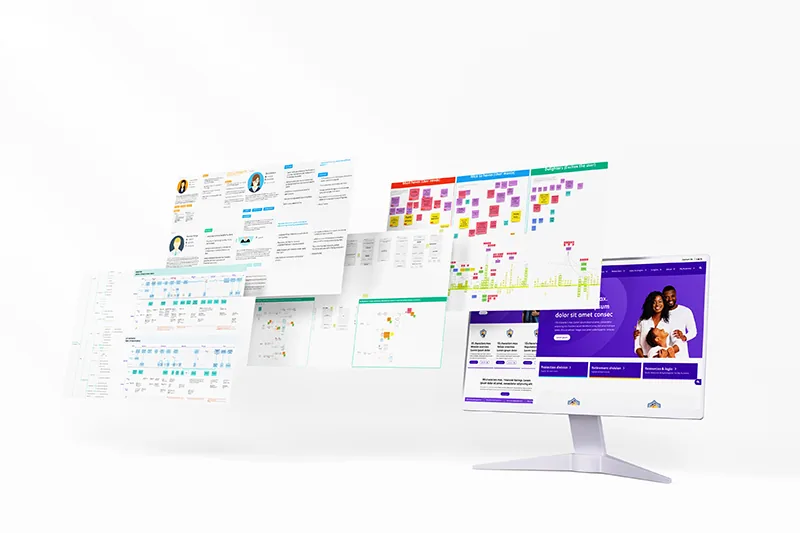
How I reduced a mid-sized web-product engagement from ~240 staff-hours to ~105 staff-hours by embedding AI across delivery while keeping humans responsible for legal, design, code, copy, and quality decisions.
Client details are private under an NDA.
~56%Total Effort ReductionReduced from ~240 h to ~105 h.
~105 hAI-Assisted EffortCompared with ~240 h pre-AI.
4 DaysContract Closed SoonerContract closed four days sooner.
Introduction / Purpose
Led an AI-accelerated UX delivery model that reduced a mid-sized web-product engagement from ~240 staff-hours to ~105 staff-hours while preserving human review across legal, design, code, and copy.
The Problem / Opportunity
Traditional delivery created drag across contract review, competitive research, synthesis, ideation, copywriting, CMS prototyping, project updates, and client communication.
Solution
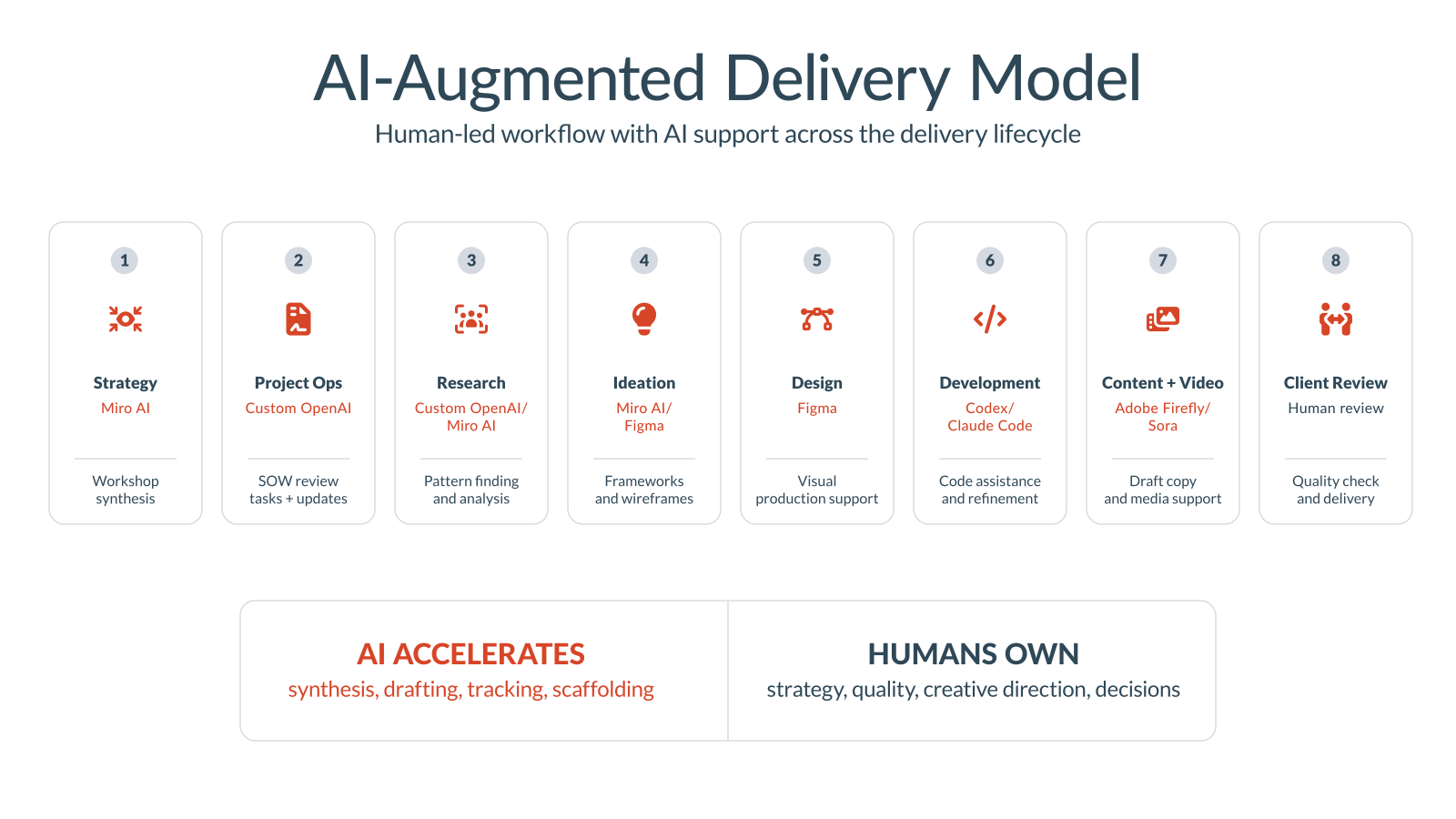
Embedded AI at key workflow points using custom GPTs, Adobe Firefly, Illustrator, HeyGen, and OpenAI Assistants, while keeping experts responsible for validation, refinement, privacy, and final decisions.
Personally owned: AI workflow strategy, delivery model design, prompt-library direction, research synthesis approach, toolchain orchestration, quality oversight, privacy safeguards, client communication, and enterprise-readiness framing.
Project Overview
Framework
Engagement Type: Mid-sized web-product engagement Effort Shift: ~240 staff-hours pre-AI to ~105 staff-hours with AI Tooling Cost: Negligible incremental cost; used SaaS licenses already in place.
The engagement required the same fundamentals as any serious UX delivery effort: contract clarity, research, competitive analysis, synthesis, ideation, design refinement, copy support, CMS prototyping, project communication, and stakeholder review.
The challenge was not a lack of skill. It was delivery drag. Too much expert time was being absorbed by repetitive tasks that still required judgment but did not always require starting from a blank page.
The opportunity was to embed AI across the workflow, reduce total effort from ~240 staff-hours to ~105 staff-hours, and preserve human accountability at every major decision point.
The goal was faster delivery without surrendering legal judgment, design quality, code review, copy quality, privacy discipline, or client trust.
The Journey: From Manual Drag to AI-Augmented Delivery
“AI was treated as a power tool, not a decision-maker. Every output still needed expert validation.”
Phase 1
Contract Review and Project Setup
A ChatGPT-based contract-review prompt supported contract and SOW redlines, with human legal sign-off retained for final judgment. This reduced the review cycle from roughly 5 days / 40 hours to about 1 day / 8 hours, helping close the contract four days sooner.
Phase 2
Research and Synthesis Acceleration
Custom GPTs helped cluster competitive and industry sources, surface trends, and summarize pasted artifacts such as links and screenshots. Competitive research dropped from 16 hours to 5 hours, while research synthesis dropped from 12-16 hours to about 1 hour.
Phase 3
Ideation, Design, and Content Support
Adobe Firefly prompts accelerated early UI sketching, with manual style refinement completed in Illustrator. GPT supported copy and micro-content, followed by human tone and accessibility review. Ideation dropped from 34 hours to 6 hours, and copy work dropped from 16 hours to 2 hours.
Phase 4
CMS Prototype and Communication Support
An OpenAI Assistant generated a PHP/JavaScript CMS plugin proof of concept with manual prompt tuning, reducing effort from 40 hours to 6 hours. GPT also supported meeting minutes and email summaries, reducing recurring project communication effort from 0.75 hours to 0.1 hours per summary cycle.
Leadership Through Uncertainty
The leadership challenge was not whether AI could make things faster. It was whether the workflow could become faster without becoming careless, generic, insecure, or difficult to govern.
1. Keeping AI in the Right Role
AI handled repetitive and pattern-heavy work: contract review support, source clustering, first-pass synthesis, ideation prompts, draft copy, CMS code scaffolding, and project summaries.
Humans still owned the decisions. Legal review, design judgment, code validation, copy tone, accessibility checks, privacy discipline, and client communication stayed in human hands.
2. Turning AI Use into a Repeatable Operating Model
The project was not treated as a one-off experiment. Prompt libraries were version-controlled, revisions were logged for traceability, and reusable templates were created so future projects could start faster without sacrificing control.
The early investment in prompt-engineering experiments took about 1.5 hours, but the reusable workflows now reduce that ramp to minutes.
AI Accelerated
Contract review support
Source clustering
Research synthesis
Ideation prompts
Draft copy
CMS code scaffolding
Meeting summaries
Humans Owned
Legal sign-off
Strategy
Design quality
Code validation
Accessibility checks
Privacy judgment
Client decisions
Designing an AI-Augmented Delivery Model
The workflow was designed around a simple principle: AI should reduce repetitive effort and increase decision velocity, while people remain accountable for quality, privacy, and client trust.
The model worked because AI was distributed across the project lifecycle instead of isolated in one task.
Stage-by-Stage Impact
Project Stage
AI Tools & Tactics
Effort With AI
Effort Pre-AI
Savings
Contract review & redlines
ChatGPT contract-review prompt + human legal sign-off
1 day / ~8 h
5 days / ~40 h
80%
Competitive / industry research
Custom GPT to cluster sources and surface trends
5 h
16 h
69%
Research synthesis
GPT summarization of pasted artifacts, links, and screenshots
1 h
12-16 h
90%
Ideation / UI sketches
Adobe Firefly prompts with manual style fixes in Illustrator
6 h
34 h
82%
Copy & micro-content
GPT copy pass + human tone/accessibility check
2 h
16 h
88%
CMS plugin POC
OpenAI Assistant generated PHP/JS plugin with manual prompt tuning
6 h
40 h
85%
PM minutes & email summaries
GPT transcribed and summarized recordings in less than 1 minute
0.1 h
0.75 h
87%
Total
AI-supported workflow with human review
~105 h
~240 h
-56%
Building a Governed AI Workflow
Speed only mattered because the workflow remained governed. AI accelerated repetitive work, but accountability stayed with people.
Human Review on Every Deliverable
Legal, design, code, and copy outputs were reviewed by humans before delivery. AI created first drafts and scaffolding, not final decisions.
Traceable Prompt Libraries
Prompt libraries were version-controlled and revisions were logged, creating traceability and making the workflow reusable across future engagements.
Privacy and Enterprise Readiness
Sensitive data was redacted before use with LLMs. For enterprise rollout, the model would shift to private-cloud LLMs, SOC 2 controls, signed DPAs, role-based access, and SLA-driven human checkpoints.
Security and Accessibility Extension
For enterprise-scale deployment, automated accessibility and security scans should be layered into CI/CD to complement human review and AI-supported production.
AI Governance Checks
Human review before client delivery
Legal sign-off for contract work
Tone and accessibility review for copy
Code validation before implementation
Sensitive-data redaction
Version-controlled prompt libraries
Traceable revisions
Enterprise pathway for private-cloud LLMs and SOC 2 controls
Challenges and Mitigations
Challenge
Mitigation
Inconsistent AI outputs
Used prompt refinement cycles and manual polish, including icon styling.
Security concerns around live AI assistant
Delivered as an offline POC and provided a redaction playbook for future enterprise deployment.
Learning curve
Invested about 1.5 hours in early prompt-engineering experiments; reusable templates now reduce the ramp to minutes.
~105 staff-hours, contract review in about 1 day / 8 hours, research synthesis in about 1 hour, ideation in 6 hours, copy in 2 hours, CMS plugin POC in 6 hours, and human review throughout.
The Outcome
The AI-accelerated workflow reduced the engagement from ~240 staff-hours to ~105 staff-hours, a total savings of about 56%, while keeping humans responsible for validation, quality, privacy, and final decisions.
The contract closed four days sooner, and the work moved faster across contract review, competitive research, synthesis, ideation, copy, CMS prototyping, and project communication. Incremental tooling cost was negligible because the workflow used SaaS licenses already in place.
The result was not automation for its own sake. It was a governed delivery model that reduced operational drag and gave the team more time for judgment, refinement, and client alignment.
Stakeholder Feedback
“I just presented the latest version in an all-staff meeting a few minutes ago and received several compliments and thumbs-up on the design.”
~240 h to ~105 h total effort reduction across the engagement.
~56% total savings while maintaining human-in-the-loop review.
4 days sooner to contract close.
80% savings in contract review and redlines.
90% savings in research synthesis.
85% savings in CMS plugin POC effort.
Lessons Learned
AI is a power tool, not a decision-maker. Every output still needs expert validation.
Ethics, privacy, and governance need to be embedded up front.
Reusable prompt and workflow libraries compound future savings.